Fig.1
The durations of the step cycle, the stance phase and
the swing phase of the fast-leg and the slow-leg in walking of a thalamic
cat on the treadmill (revised by authors from [Yanagihara
et al. Neuro. Res., 1993]). The speed ratio (fast belt speed/slow
belt speed) was 0.61 (m/s) / 0.36 (m/s), that is approx. 0.17. In both
diagrams, (C): a cat walked on tied-belt. (D)&(E): a cat walked
on split-belt in the first trial. (F): a cat walked on split-belt in the
third trial. It is named (C): normal
locomotion, (D)&(E): early adaptation
and (F): late adaptation. We can consider
that this early adaptation is induced at the spinal cord, and
that late adaptation is induced at the cerebellum. At the
beginning of split-belt walking, durations of the stance phase and the
swing phase of the fast-leg quickly decreased: (G) and increased: (H),
respectively. On the other hand, durations of the stance phase and the
swing phase of the slow-leg almost kept constant: (I) and quickly
decreased: (J), respectively. Fluctuations of durations were very large in
(D), still not small in (E) and small in (F) in both legs. The gaps in
steps meant standing for approx. 20[min] on the treadmill with no motion.
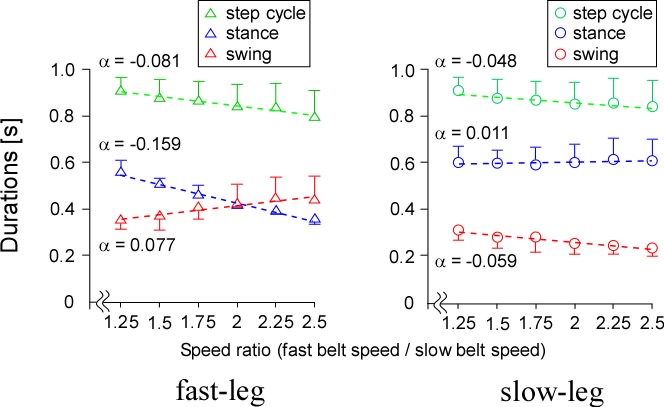
Fig.2
The results of experiments in split-belt
treadmill walking with hindlimbs of spinal cats (revised by authors
from [Frigon et al. J. of Physiol., 2017]).
The slow belt speed was fixed at 0.4 (m/s). The speed ratio (fast belt
speed/slow belt speed) was increased from 1.25 to 2.5. The durations of
the step cycle (green), the stance phase (blue) and the swing phase (red)
are shown for the fast-leg:~(a) and the slow-leg:~(b). Each plot is the
mean + or - SD. Each dotted line means the approximate straight line.
Alpha means the slope of the straight line.
Fig.3 (not yet in public)
We conducted experiments in split-belt
treadmill walking with hindlimbs of Kotetsu using the new spinal cat
model. The slow belt speed was fixed at 0.132 (m/s). The speed ratio (fast
belt speed/slow belt speed) was increased from 1.25 to 2.5.
As
a result, the pattern of changing durations of the swing and the
stance phases from tied-belt (speed ratio=1) to split-belt (speed
ratio=1.75) is quite similar to the one of early adaptation of
thalamic cats (Fig.1-(E)). The pattern of changing durations of
the swing and the stance phases according to the speed ratio is very
similar to the one of spinal cats (Fig.2).
